
A Tool for the Global South
Scaling Up
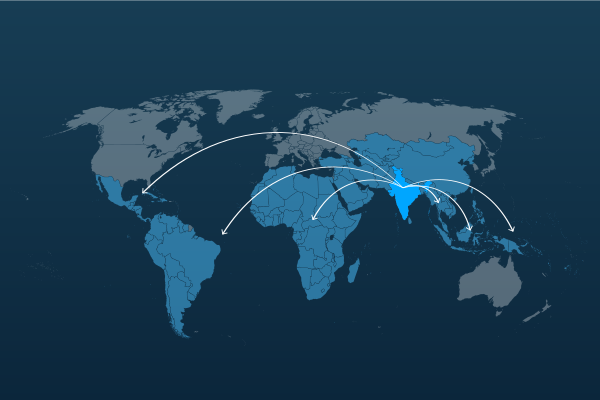
Researchers affiliated with the Emissions Market Accelerator helped the Indian state of Gujarat design and launch the world’s first particulate pollution market. They then worked with Gujarat to launch a second market in the city of Ahmedabad—Gujarat’s largest city and a major industrial hub. Today, 20 million people are breathing cleaner air in Gujarat due to these markets.
The Emissions Market Accelerator is now scaling its efforts. The team is working with the Gujarat government to establish a sulfur dioxide trading market and a wastewater pollution market. They are also supporting a sulfur dioxide market in the Indian state of Maharashtra and beginning to design a market in the Indian state of Rajasthan. Discussions are also underway to expand to several other Indian states, as well as internationally
Proof of Concept
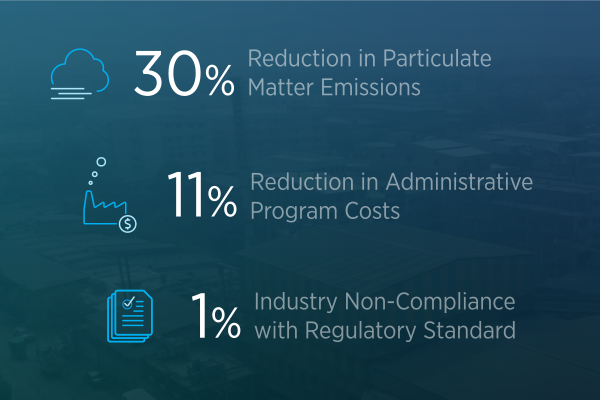
The win-win-win achieved by the particulate pollution market in the Indian state of Gujarat is not new for pollution markets. They’ve proven to be effective in reducing pollution at a lower cost than traditional rules in countries around the world, including the United States, Europe and Canada. For example, in the United States, markets for sulfur dioxide reduced pollution by 40 percent between 1980 and 2003. Yet, prior to the Gujarat market, there wasn’t any evidence that a market could work in the Global South.

Why the Global South?
Forty-nine of the top 50 countries with the most polluted air are located in the Global South. Further, 82 percent of CO2 emissions over the remainder of the century are projected to occur there.
Yet, the Global South hasn’t had the tools to address its environmental burden without compromising economic growth because they have almost exclusively relied on command-and-control style regulatory approaches that are costly and difficult to enforce. By contrast, emissions markets are a flexible, transparent approach that allow for stronger compliance at lower cost.